The AI unicorn with a valuation of over 20 billion yuan is standing on the edge of a broken funding chain - its cash on paper is only enough to burn for another 9 months, and even with 8.9 billion yuan in bank credit, it is still at its limit to last for two years? This is the cruel reality exposed in the prospectus of Zhipu's impact on "China's first AI stock".
But things are far more than just "out of money".
Firstly, the money burns faster and faster. In the first half of the year, the consumption rate of a loss of 1.75 billion yuan and an average monthly loss of 300 million yuan far exceeded the revenue growth rate, while the average payment cycle skyrocketed from 21 days to 112 days. Large customers are replaced every year, mostly in one-time transactions, and even there is a phenomenon of purchase sales inversion where the purchase amount from customers is higher than the sales amount. Behind this is a signal far more dangerous than cash flow: is Zhipu's business model losing its ability to generate revenue?
Secondly, the more computing power is purchased, the more expensive it becomes. Over the past three years, computing service fees have skyrocketed 70 times, devouring 70% of research and development expenses, and all expenses have become "consumables". Zhipu has fallen into a death spiral of "not burning money to buy computing power is equivalent to technology retirement, and continuous investment will lead to exponential expansion of losses". Nevertheless, its GLM series models have been praised by the journal Nature and listed as global competitors by OpenAI. The huge gap between technological achievements and commercial value has become the most contradictory question in the capital market.
Finally, the business is getting heavier and heavier. 85% of the revenue relies on localized deployment of "project-based outsourcing", but when they want to switch to cloud SaaS, they find that the gross profit margin has fallen to -0.4%. Giants such as Alibaba and Tencent are sweeping the market with free APIs and migration subsidies. The "independent and controllable" claimed by Zhipu is an advantage on the G-end, but becomes a shackle on the B-end and C-end - it must prove that the model's ability can crush its opponents in vertical scenarios, otherwise all investment will only be a "wedding dress" for cloud vendors.
From the A-share market to the Hong Kong stock market's 18C chapter listing, from rumors of layoffs to controversies over "beautifying financial statements", Zhipu's IPO is no longer just about "extending its life". This star company, which has been bet on by investors and founders for a "billion dollar endgame", is exposing the collective predicament of China's big model industry in the most extreme way: between technological idealism and the cruel reality of capital, between the arms race of computing power and the gap between commercial landing, can "China's first AI stock" exchange a ticket worth 20 billion for a pass through the "most dangerous road"?
The financial data disclosed in Zhipu's prospectus is still being interpreted.
After comparing two sets of data in the prospectus, a blogger found that "if we follow the rhythm of a net loss of 1.751 billion yuan and an average monthly loss of 300 million yuan as of the first half of 2025, the money currently in hand (cash and cash equivalents of 2.552 billion yuan) is only enough to support 9 months
This topic has also raised many questions about its motives for going public - is it really out of money?
But some people believe that the above algorithm is crude: firstly, it ignores the revenue supplement of Zhipu, and secondly, it ignores the latest financial information supplemented in the prospectus - a supplementary text below the comprehensive cash flow statement: as of October 31, 2025, we recorded a total of RMB 8943.1 million in cash and cash equivalents, short-term investments measured at fair value in profit or loss, and available commitment bank financing.
The controversy immediately turned to another direction: Can bank credit funds be considered cash flow?
Strictly speaking, credit funds are not equivalent to cash, but in companies planning to go public, they are often seen as an important supplement to liquidity. And the prospectus of Zhipu did not disclose its triggering conditions and lending pace, which is also a key point that cannot be bought.
If the dispute over credit funds is temporarily put on hold, the most direct source of cash flow supplement is the revenue side.
According to the prospectus, Zhipu's operating revenue in 2022, 2023, 2024, and the first half of 2025 will be RMB 57.4 million, RMB 124.5 million, RMB 312.4 million, and RMB 190 million respectively, with a total revenue of over RMB 680 million. The compound annual growth rate from 2022 to 2024 will reach 130%.
If calculated roughly based on the compound annual growth rate, Zhipu expects its revenue to be 700 million yuan in 2025 and 1.6 billion yuan in 2026. In addition, Zhipu CEO Zhang Peng has previously stated that it is expected that revenue may increase fourfold by 2025, reaching approximately $168 million (about 1.2 billion yuan).
That is to say, it is optimistically expected that Zhipu's total revenue in the next two years will reach 2.3-3.6 billion yuan, plus the current cash flow of 2.6 billion yuan. Based on the current monthly average loss of 300 million yuan (a loss of 3.6 billion yuan per year), it is probably enough to sustain for another 2 years.
Even with the credit of over 6 billion yuan included, it is still a bit "stretched thin" in the face of such a large consumption.
At the same time, what is even more fatal is the problem of "customer stability" and "inverted procurement and sales" on its revenue side.
On the one hand, in the reports of clients whose transaction volume exceeded 10% of their revenue during the reporting period, it was not only shown that most of the major clients had only cooperated for 1-2 years, but also that from 2022, 2023, 2024 to the first half of 2025, the top five clients of Zhipu did not overlap and mostly belonged to one-time delivery relationships with no follow-up.
On the other hand, Zhipu's large orders are suspected of having "customers as virtual, suppliers as real". In the prospectus, many major clients are also major suppliers of Zhipu, but clients A, P, and Q have all experienced situations where their purchase amounts exceed their sales. For example, from 2022 to the first half of 2025, Zhipu sold 242 million yuan to its largest client A, but purchased 247 million yuan from them.
In addition, cash flow is still constrained by the reality of "heavy projects and slow payments". The average payment collection time of Zhipu has been extended from 21 days in 2023 to 112 days in the first half of 2025, far exceeding the average delivery time of the project. The prospectus also indicates that the speed of payment collection is mainly affected by localized deployment of customers.
Meanwhile, the reality facing Zhipu is that compared to revenue growth, the expansion of losses is more steep, almost exponential growth. The adjusted net losses of the company from 2022 to 2024 were RMB 97 million, RMB 621 million, RMB 2.4656 billion, and RMB 1.752 billion in the first half of 2025, respectively.
If the controversy over cash flow is just the trigger, then the continuous expansion of research and development investment leading to increasing losses year by year may be the real "explosion point".
According to the prospectus of Zhipu, R&D expenses account for the vast majority of Zhipu's financial losses. From 2022 to 2024, and in the first half of 2025, Zhipu's R&D expenses were 80 million yuan, 530 million yuan, 2.2 billion yuan, and 1.59 billion yuan, respectively.
Among them, the "computing power service fee" (including model training and providing services to customers through cloud deployment) has skyrocketed from 15 million yuan in 2022 to 1.145 billion yuan in the first half of 2025, reaching over 70% in three years. These R&D costs are all calculated as cost losses, and "no R&D expenses have been capitalized".
So, for the almost "unlimited burning of money" in computing power investment, many people question: after burning the money, what is left?
At least in terms of technical indicators, Zhipu has not been 'burned without gain'.
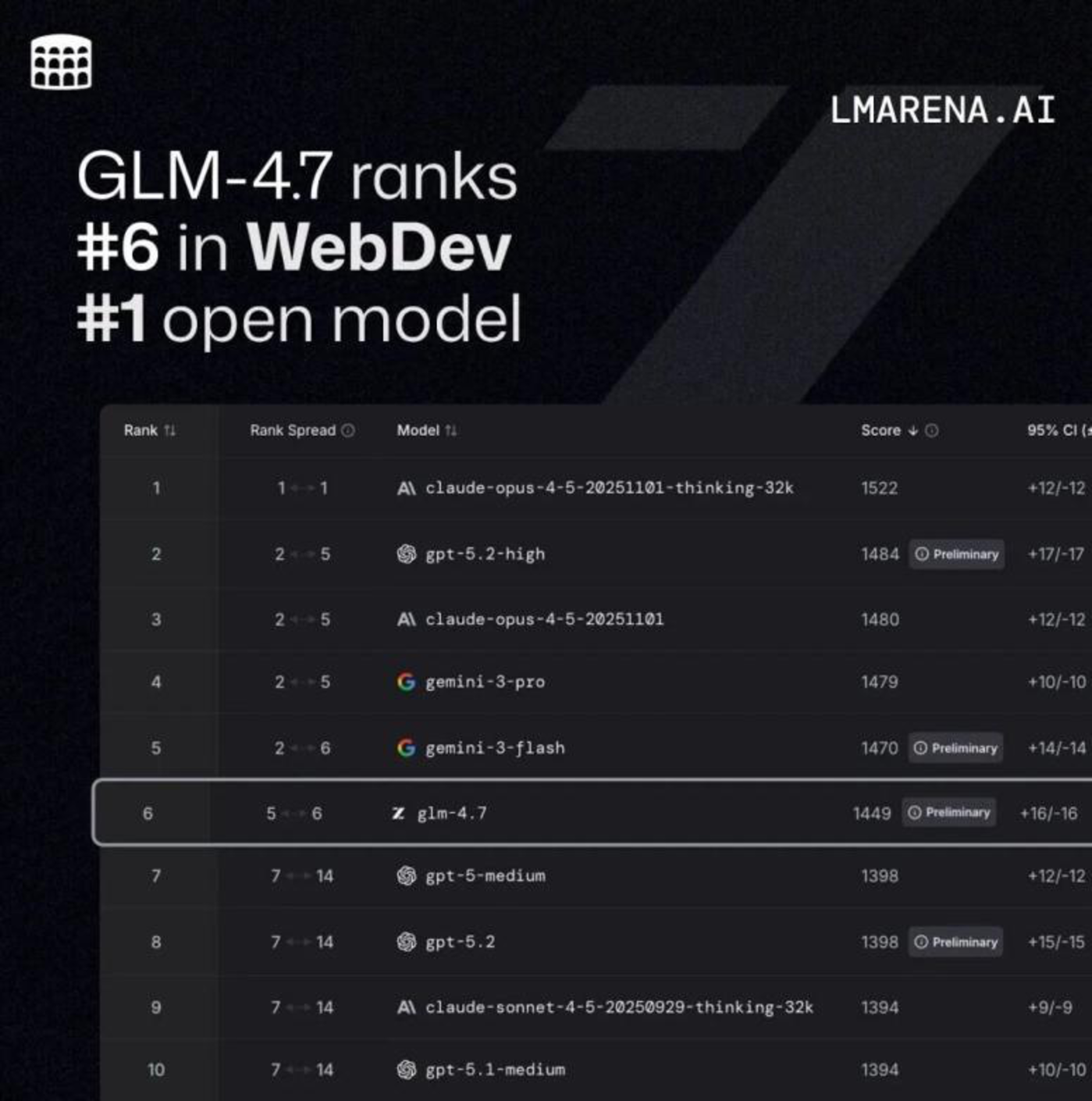
Its GLM series models complete a base iteration every 3-6 months, especially in the coding ability of the models, achieving key breakthroughs and ranking first in open source and domestic programming in the Code Arena.
In May 2024, the internationally renowned academic journal Nature regarded Zhipu's ChatGLM model as an outstanding representative of the Chinese pedestal model. In June of this year, it was listed as a major global competitor by OpenAI in the United States.
On December 23rd, GLM4.7 was launched, surpassing GPT-5.2.
Besides computing power, salary is the second largest cost expenditure in the research and development process.
The salary costs for R&D personnel in 2022-2024 are RMB 42 million, RMB 137 million, and RMB 324 million respectively, and RMB 266 million in the first half of 2025. Currently, there are 657 R&D personnel.
According to the AI talent report previously released by Liepin Big Data Research Institute, the average annual salary for domestic AI related job recruitment in 2022 is 331500 yuan, of which the average annual salary for AI algorithm engineers can reach 460000 yuan.
If we extrapolate based on an average annual salary of 500000 yuan, the salaries of Zhipu's R&D personnel are generally within a reasonable range in the domestic AI industry.
But if we look at top model companies overseas: a document reveals that by 2025, OpenAI's technical staff can earn an annual salary of up to $500000 (about 3.5 million yuan), while Anthropic's research engineers can earn up to $690000 (about 4.9 million yuan).
According to data from technology recruitment company Harrison Clarke, the annual salary of top AI engineers has exceeded the $10 million mark, and the typical salary package has also reached $3 million to $7 million, a surge of about 50% compared to 2022 levels. According to reports, Meta CEO Mark Zuckerberg has offered compensation packages worth billions of dollars to several top AI researchers.
In contrast, Zhipu has shown significant restraint in manpower investment, and there have even been reports of layoffs previously. Although the official response to the rumors circulating online is false, there are still employees who claim to have resigned and told the media, "Zhipu is in a hurry to lay off employees in order to focus on its financial statements before going public." The employee also said, "The closure of the production and research center should be Zhipu's intention to gradually adjust its customized projects. The production and research departments are generally cost centers and cannot bring direct income." He also revealed that Zhipu is considering outsourcing the development of private projects in the future, in order to standardize product delivery as much as possible and reduce costs.
Excluding research and development expenses, "sales and marketing expenses" were attributed by Zhipu as another factor contributing to the expansion of losses.
In 2022, 2023, 2024, and the first half of 2025, Zhipu's sales and marketing expenses will reach RMB 15 million, RMB 101.2 million, RMB 387.5 million, and RMB 208.6 million, respectively.
In the prospectus of Zhipu, it is explained that "in order to quickly seize opportunities in emerging markets, the sales and marketing team has been expanded, and advertising investment has been increased", resulting in an increase in this part of the expenditure.
The increase in this part of the expenditure is consistent with its performance in vigorously increasing cloud deployment and expanding business in the Southeast Asian market starting in 2024.
But compared to the huge R&D investment that often consumes 2 to 3 billion yuan per year, marketing and sales expenses seem not worth mentioning.
Under the premise that computing power cannot form assets and model capabilities may be equalized, can Zhipu transform "burning money" into "sustainable investment" through a business model?
Overall, the commercialization of Zhipu is walking on two legs:
A thick leg: providing localized deployment and customized AI solutions for large clients such as government, finance, and energy, accounting for 85%.
A slim leg: providing model calls to developers and small and medium-sized enterprises through cloud APIs and subscription services (MaaS), accounting for 15%.
The core advantage of this thick leg is obvious - state-owned enterprise clients have a rigid budget to pay for "safety, controllability, and privatization". Single project pricing is high, which can quickly drive revenue growth. In 2024, the top five clients of Zhipu contributed a revenue of 142 million yuan, accounting for 45.5%. And maintain a high gross profit margin of over 50%.
But the drawbacks of thick legs are also obvious - in addition to the "slow payment collection and lack of sustainability" mentioned above, ToG's "project-based" business has a linear growth in revenue and manpower investment, which means that if you want to make more money, you need to hire more people in order to better serve local customers. This model seems to have turned Zhipu into a heavy asset company for "software outsourcing".
Zhipu also recognized the problems with this type of business and began to strengthen the training of "slim legs". From 2022 to the first half of 2025, the revenue share of cloud deployment will increase from 4.5% to 15.2%, attempting to improve the shift from "customized path dependence" to "standardized services" with a focus on SaaS.
Currently, there are results in the data. According to the prospectus, Zhipu Cloud MaaS and subscription business show an exponential growth trend. Nine of the top ten Internet companies in China use the Zhipu GLM model, and the revenue from paid traffic exceeds the sum of all domestic models. The daily token consumption has increased from 500 million in 2022 to 4.6 trillion in the first half of 2025.
Zhipu CEO Zhang Peng has stated that he hopes to increase the revenue share of API business to half.
But in terms of commercialization, it was a big surprise - the gross profit margin of cloud deployment dropped from 76.1% to -0.4%. One important reason behind this is the fierce competition among domestic cloud providers. Many giants offer free migration services, including large model APIs, in order to sell cloud resources.
The label of "independence and security" touted by Zhipu on the G end seems to be ineffective for small and medium-sized B-end enterprises and C-end enterprises that need "cheap and easy to use".
Unless it can prove that in certain vertical scenarios, its model capability is enough to outperform other vendors.
Zhipu's judgment on the future business model proves that he wants to do it this way - "Compared to selling models, the future industry is a business model that focuses on buying capabilities and services. This also means that once it falls behind in terms of foundational capabilities, all upper level applications and business models will become skyscrapers
Meanwhile, OpenAI has recently suspended several non core projects, including the Sora video generation model, and will focus all resources on improving the performance and user experience of its most core ChatGPT over an eight week period.
Therefore, this also explains why Zhipu needs to invest a huge amount of research and development computing power - in exchange for the "computing power admission ticket" paid for a higher commercial ceiling. At the same time, it also puts it in an awkward situation: buying computing power "burns money" and incurs losses, but not continuously investing computing power is almost equivalent to exiting directly.
However, it is very difficult to practice the "cloud deployment" leg in China, whether it is in terms of payment willingness, API comparison, or institutional customers who currently account for a high absolute revenue contribution.
In addition, Zhipu has previously attempted an A-share IPO, but has not yet received a formal opinion on the A-share listing, and voluntarily decided to go public on the Hong Kong stock market under Chapter 18C (Special Technology), which has provided a footnote to its uncertain future.
From an investment perspective, the ultimate bet of investors may be that Zhipu can become the last survivor in the trillion dollar endgame.
From the perspective of the capital market, the significance of Zhipu's listing is far from "extending its life". As a Chinese big model company with a valuation of over 20 billion and a breakthrough in the "AI first stock" market, its more important value lies in being a touchstone for the industry on a more transparent stage, verifying the path and providing experience for the entire market.